
Occupational disease issues in high-tech industries : Focused on the public interest NGO data on the semiconductor and display industries in South Korea
Abstract
This study analyzed occupational diseases in South Korea's high-tech semiconductor and display industries, focusing on claims and compensation from 2008 to 2022 reported in a NGO group.
Using data from the NGO SHARPS (Supporters for the Health and Rights of People in the Semiconductor Industry), the study analyzed the number of occupational disease claims, approvals, and approval rates by factors such as gender, age, working period, and disease type (cancer vs. non-cancer).
The total number of recorded cases was 179. Of these, 71 (40%) were approved by the Korea Workers' Compensation and Welfare Service (KWCWS), 27 (15%) were initially disapproved but later approved in court, 52 (29%) were disapproved, 22 (12%) are still in progress, and 7 (4%) were withdrawn. Among the 179 cases, there were 133 cancer cases and 46 non-cancer cases, with more female cases (111) than male cases (68). The total number of approved cancer cases was 76, with more approvals for females (47) than males (29). Among cancer cases, leukemia had the highest number of approvals (22), followed by breast cancer (16) and brain cancer (13). For non-cancer diseases, multiple sclerosis and aplastic anemia had the highest number of approvals (4 each), while lupus and renal failure had fewer. The total number of approved non-cancer cases was 22, with more approvals for females (15) than males (7).
The average time for KWCWS to determine cases was 974 days, significantly longer than the 569-day average across other industries. A shift in decision-making occurred after two Supreme Court rulings in 2017, influencing the approval of occupational disease claims.
The study emphasizes that workers’ compensation is not an act of benevolence but a right, and it should function as social insurance. In South Korea, this issue cannot be resolved solely through existing government policies. The study highlights the significant roles of various stakeholders, including public interest NGOs, in the evolution of decision-making in workers’ compensation cases for occupational diseases.
Keywords:
Cancer, NGO, Occupational Disease, Semiconductor industry, Electronics industryIntroduction
The semiconductor industry, which began mass production in the 1960s, has become a crucial sector in countries such as Korea, Taiwan, and the United States. Recent global supply chain challenges and growing demand have driven substantial expansion in manufacturing worldwide. Since the 2010s, rising nationalism and strategic policies have intensified competition, particularly between the U.S. and China, while the EU and Japan have also increased their involvement.
Since the 1980s, the industry's environmental and health risks—first highlighted by groundwater contamination in Silicon Valley—have garnered growing attention. Numerous lawsuits and studies have investigated these health risks, but most findings remain inconclusive. A 2014 review linked semiconductor production to reproductive risks, including spontaneous abortion, congenital malformations, and reduced fertility, as well as potential cancer risks such as non-Hodgkin’s lymphoma and leukemia [1]. A 2019 meta-analysis identified higher risks of spontaneous abortion among fab workers, particularly those in photolithography, likely due to chemical exposure[2, 3]. However, a 2022 meta-analysis found no significant increase in cancer incidence or mortality among semiconductor workers[4], though issues like control group limitations and the healthy worker effect may have underestimated certain risks.
Despite these findings, compensation systems face challenges in relying solely on indisputable evidence to establish work-related illnesses. In industries like semiconductors, with relatively short histories and frequent process changes, existing causal frameworks are often insufficient due to limited research. In South Korea, the compensation system for occupational diseases has been reshaped by legal and administrative reforms following semiconductor-related disputes[5,6]. The 2017 Supreme Court adopted a more flexible approach to causation[7], and in 2018 the Ministry of Employment and Labor introduced expedited review for eight cancers in semiconductor and display workers [8]. These reforms contributed to higher approval rates, with 174 claims filed and 88 (50.6%) approved between 2012 and 2023, though approval rates remain higher in large enterprises compared to SMEs [5]. Nevertheless, research continues to emphasize the difficulty of establishing causality in industries with rapid process changes and limited exposure data[6, 9].
This study analyzed occupational disease cases in South Korea's electronics industry, focusing on those reported to public interest NGOs, including both those initially approved and compensated through the government’s compensation system, and those initially denied but later approved through successful court cases in South Korea, where occupational diseases in the electronics industry have become a significant social issue.
Methods
This study used the data the covering the years 2008 to 2022 and is from SHARPS (Supporters for the Health and Rights of People in the Semiconductor Industry), a public interest NGO in South Korea that advocates for occupational health and safety including assisting with workers’ compensation claims.
In South Korea, workers' compensation for occupational diseases is managed by the Korea Workers’ Compensation and Welfare Service (KWCWS). The process involves an initial investigation, followed by specialized investigations if needed, conducted by organizations like the Institute of Occupation and Environment. A committee of experts reviews the case to determine if the disease is occupational. Quick approvals are granted for diseases with established work-relatedness. Workers can request re-examinations or pursue legal action if their claims are denied [10].
In South Korea, the public interest NGO SHARPS has played a crucial role in addressing occupational diseases among electronics workers. Established in November 2007 after the death of a 22-year-old female worker from leukemia in Samsung's semiconductor division,
Initially focused on Samsung workers, SHARPS later extended its support to employees in other high-tech electronics companies. They developed a detailed database, which includes information on workers' diseases, workplace conditions, compensation claims, and litigation outcomes. The data was provided with workers' consent for research purposes, and each individual's information was anonymized for analysis in this study.
In the 2008-2022 data provided by SHARPS, the number of occupational disease claims, approvals, and approval rates were examined by gender, age, working period, duration of employment until disease diagnosis, and type of products. Additionally, diseases were classified into cancer and non-cancer categories, and the number of claims, approvals, and approval rates by gender were investigated for each category.
This study was approved by the Changwon National University Institutional Bioethics Committee (No. 7001066-202308-HR-051).
Results
Table 1 classifies a total of 179 cases from 2008 to 2022 into various categories and summarizes the number and percentage of workers’ compensation claims for occupational diseases. The number of approved cases (98 cases) here includes both those approved by KWCWS (71 cases) and those disapproved by KWCWS but later approved by the court (27 cases) as shown in Figure 1.

Summary of workers’ compensation claims for occupational diseases in electronics companies filed with the support of SHARPS
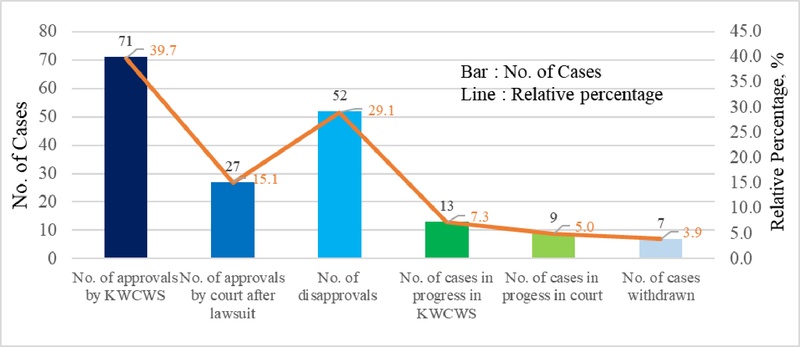
Classification according to KWCSW or court processes for the 179 cases reported to SHARPS during 2007-2023. KWCWS: Korea Workers’ Compensation and Welfare Service.
More compensation cases were filed by female workers (111 cases, 62%) than male workers (68 cases, 38%), as most operators handling chemicals are women. Many of these operators were under 20 years old (102 cases, 57%) due to employment during or shortly after high school, followed by those in their 20s (53 cases, 30%). This young female workforce has faced reproductive occupational diseases such as menstrual irregularities, infertility, and premature birth [3].
Compensation cases increased during the 1980s as the semiconductor industry grew, peaking in the 1990s and 2000s with the rise of semiconductor and LCD manufacturing (Figure S1). Approval rates for occupational diseases were higher for workers employed before 2010 (47–82%) than after 2010 (39%) (Table 1). Despite fewer claims (31 cases) and lower approval rates after 2010, some cases are still recognized as occupational diseases.
The age of disease onset was most commonly in the 20s to 30s (127 cases, 71%), with 5 cases (3%) in those under 20. The time from employment to disease onset ranged from less than a year to 40 years, most frequently 2–20 years (2≤~<5 years, 45 cases; 5≤~<10 years, 60 cases; 10≤~<20 years, 42 cases). Longer employment periods correlated with higher approval rates for occupational diseases.
Table 2 summarizes occupational disease claims for cancer and non-cancer illnesses by gender, totaling 179 claims—111 (62%) from females and 68 (38%) from males—highlighting gender disparities and variations in approval rates. Of these, 133 (74%) were cancer-related, with 76 approvals (57%) and 38 disapprovals (29%). Leukemia (63% approvals) and breast cancer (57%) had higher approval rates, reflecting more established recognition criteria.
Approval status of occupational diseases for cancer and non-cancer diseases reported to SHARPS
For non-cancer diseases, including multiple sclerosis, lupus, and Parkinson’s, there were 46 claims, with 22 approvals (48%) and 14 disapprovals (30%). Gender differences emerged, such as renal failure, where men had two approvals and women had two disapprovals.
Semiconductor workers accounted for 103 claims (58%), LCD workers 42 (23%), and other electronics workers 34 (19%), with approval rates of 55%, 48%, and 62%, respectively.
Figure 1 shows 179 occupational disease claims reported to SHARPS. Of these, 71 cases (40%) were approved by KWCWS, 27 (15%) were disapproved by KWCWS but later approved in court, and 52 (29%) were disapproved outright. Additionally, 22 cases (12%) are in progress, and 7 cases (4%) have been withdrawn.
Table 3 compares the process through which 27 cases that had been rejected by KWCWS were approved by the court before and after 2018. As shown in Table 3, of the 12 cases approved for occupational diseases before 2018, 3 cases (25%) were closed in the first trial, 7 cases (58%) were closed in the 2nd trial, and 2 cases went to the 3rd trial at the Supreme Court (17%). However, since 2018, all 15 cases have concluded in the first trial.
Process comparison of 27 cases approved by the court as occupational diseases before and after 2018
Table 4 categorizes the 179 cases reported to SHARPS by major South Korean electronics companies, including Samsung, SK-Hynix, and LG. Samsung accounted for 132 cases (74%), followed by SK-Hynix with 13 cases (7%) and LG with 5 cases (3%). Within Samsung, the majority of claims came from Samsung Semiconductor (71 cases, 40%) and Samsung Display (31 cases, 17%). For SK-Hynix, 9 claims were from its employees and 4 from subcontractor employees.
Number of claims and approvals for occupational diseases by major South Korean electronics companies from data submitted to SHARPS
The overall approval rate for occupational diseases was 54.7%. Samsung-related companies had a similar approval rate of 54.5%, while SK-Hynix (69%) and LG (60%) had slightly higher rates. However, Samsung Semiconductor's subcontractor had a lower approval rate of 38% (3 out of 8 claims) , which was lower than the average.
These descriptive findings are not only statistical outcomes but also point to systemic implications. The predominance of young female cancer cases highlights the vulnerability of a workforce concentrated in chemical-handling jobs. The long average deliberation time (974 days vs. 569 days in other industries) indicates institutional barriers within the compensation system. Differences in approval rates by employment period and company size further reveal structural inequities in access to compensation. Taken together, these patterns provide the empirical foundation for the broader institutional and policy issues that are addressed in the Discussion.
Discussion
Building on these empirical patterns, the Discussion interprets how demographic and disease-specific findings connect to institutional and policy dynamics in South Korea. In particular, the gender and age distributions, the predominance of cancer cases, disparities in approval by employment period and enterprise size, and the long deliberation times directly inform the systemic challenges and reforms discussed below.
Workers employed earlier had higher approval rates for occupational diseases due to longer work periods before diagnosis. Before the 1990s, smaller semiconductor wafers required more manual labor, increasing exposure to hazardous chemicals. For example, Samsung Semiconductor produced 4- and 6-inch wafers until 2005, when automation became more common [10]. The introduction of 12-inch wafers around 2010 improved workplace cleanliness, as automated processes eliminated direct operator involvement [10]. Occupational diseases primarily affected workers handling smaller wafers or employed before 2010.
Job types also shifted over time. Before the 1990s, most workers were in semiconductor-related works, but with the growth of the display industry, display workers increased. Of the 40 display-related cases in SHARPS, 38 involved workers employed after the 1990s, reflecting this transition. Determining occupational diseases took an average of 974 days for KWCWS, much longer than the 569-day average for all industries, due to lengthy investigations by KOSHA [11].
The 2017 Supreme Court rulings significantly impacted occupational disease approvals. The court recognized that strict scientific proof is not always required, emphasizing "significant causal relationships" based on workplace hazards, health, and exposure duration. This "Principle of Presumption of Occupational Diseases" led to higher approval rates, particularly for eight major illnesses in semiconductor and display workers. Policies introduced in 2018 eased the burden of proof, facilitating faster reviews, but the approach has not been widely expanded beyond the electronics industry [7,12].
Based on the lengthy deliberation period until the final decision mentioned above, the precedents of the Supreme Court, and above all, the efforts of SHARPS and some experts, the Ministry of Employment and Labor announced in 2018 that it would provide support to semiconductor and display workers. This support is part of measures to relieve workers' burden of proof and expand compensation for occupational diseases. By improving the occupational disease review process, if certain conditions are met for the eight major illnesses (leukemia, multiple sclerosis, aplastic anemia, ovarian cancer, brain tumor, malignant lymphoma, breast cancer, and lung cancer) previously recognized as occupational diseases, a professional investigation of work-relatedness is exempted and a quick review is conducted. The quick review applies to workers who joined the company before January 2011 and retired after January 1996, worked for at least one year, and developed the disease within 10 years of retirement considering the latency period. This policy of the Ministry of Employment and Labor may have increased the occupational disease approval rate in the semiconductor and display industry since 2018. Some experts argue that it was unfair to industries other than the electronics industry. Considering the nature of the occupational injury compensation insurance program, such expansion of compensation should be extended to other industrial sectors as well, instead of being limited to strict medical causality as in the past. However, there is no proof that a significant expansion of compensation to other sectors was achieved as of 2024.
A previous study highlighted five key challenges in approving workers' compensation for occupational diseases in South Korea: adjudicating work-relatedness, trade secrets, burden of proof, causation tests, and benefit of the doubt [13]. For example, A study revealed that 33% of chemicals used in semiconductor manufacturing were classified as trade secrets [14]. The Ministry of Trade and Samsung have also restricted access to work environment data, citing national security concerns. These claims of trade secrets cover not only chemicals but also entire electronics companies. The Ministry of Trade, Industry, and Energy agreed to a request from Samsung to block release of information through work environment measurement reports and South Korea’s National Assembly subsequently enacted the Industrial Technology Act, codifying restrictions on information release while citing concerns about economic competition [13]. In 2022, South Korea’s National Assembly passed another law concerning technology protection that regulates dissemination of technologies deemed to be of national strategic importance to foreign countries. This law expands the scope of restrictions on information release present in the Industrial Technology Act. Therefore, it is difficult for workers and external experts to evaluate risks as well as understand the use of hazardous substances and work processes in the industry. While such secrecy protects business interests, it has hindered workers' rights and safety management. In the past, this worked to the advantage of employers, but since 2018, it has somewhat benefited applicants seeking workers’ compensation for occupational diseases. However, this secrecy will not help prevent or manage workplace risks. Civil society criticism has partially addressed these issues, as seen in a 2017 Supreme Court ruling [14].
Samsung Semiconductor and Samsung Display have drawn significant attention due to a high volume of claims, driven by cases such as a 22-year-old female operator who developed leukemia. Samsung disputed studies linking hazardous chemicals to health risks and withheld critical information under trade secret claims, leading to public distrust [15-17]. NGO efforts reframed these concerns as human rights issues, increasing worker awareness and advocacy for compensation.
The occupational disease compensation system in a society needs to be understood in the context of that society's history and culture. In South Korean society, the perception of occupational diseases has changed over time. The recognition and management of occupational diseases in a society also differ for each group (manufacturing sector, large corporations or SMEs, men or women, unionized workforce or non-unionized workforce, formal workers or informal workers, migrant workers, platform workers, etc.), and an existing study has identified the causes of this including political, economic, health and safety, and human rights perspectives [13]. However, as shown in Figure 3 and Table 6, the fact that this issue is less prominent among SMEs and subcontractors indicates that some of these four factors are still obstacles.
Applying these four causes to the electronics industry, the following inferences can be made. The issue in the political and economic dimension is that, firstly, the implementation of safety and health regulations and the approval of workers’ compensation claims for occupational diseases have been considered according to government regulations, that is, in a top-down manner. Moreover, previously there was a strong belief that occupational diseases would not occur in the semiconductor and display industries due to their image as clean industries. However, through the efforts of experts helping patients and SHARPS, it has been revealed that the system itself may be flawed and that a clean room is clean from a product standpoint, not necessarily for the workers. The issue of occupational diseases in the semiconductor industry was initially regarded as an individual's disease unrelated to work, but gradually it became a concern in the industrial workplace due to factors such as the numerous chemicals used, claims of trade secrets, lack of safety and health management, and frequent alarms from chemical leak detection sensors. Safety and health issues emerged as social issues because of poor health conditions and the occurrence of many reproductive system diseases and rare cancers. Public interest NGO activities also approached this from a human rights perspective, highlighting that workers who contract cancer or rare diseases while working at electronics companies suffer from financial difficulties, experience the reality of an incurable disease, struggle with the lack of interest from the government and employers, and live with pain that extends to their families.
Another reason is that the three major companies—Samsung, SK Hynix, and LG Display—operate their own financial support compensation programs to provide compensation for suspected work-related diseases, which has raised awareness among workers [18]. Such programs have many advantages, including providing urgent financial compensation even for workers whose occupational diseases are not approved, reducing conflicts between companies and workers, and addressing the limitations of the government's workers’ compensation system. However, the workers’ compensation system for occupational diseases must be made more effective and fairer for all workers, rather than serving as a benevolent gesture to certain industries or specific workers [13].
Just as the electronics industry has grown rapidly in South Korea, the issue of occupational diseases has rapidly emerged since 2007 and continues to this day. To resolve these occupational disease issues, various solutions have been proposed and implemented. After examining the 30-year history of occupational diseases in South Korea, it was stated that changes should be made at the system level rather than at the program or project level, and that goals and directions for all stakeholders should be interlinked and unified. The role of each stakeholder is summarized in Table 7 of that paper [13].
This study identified unknown safety and health risks in high-tech industries such as semiconductor and display manufacturing. The hazards of new processes and chemicals in high-tech industries can damage the lives and health of workers without our awareness. Preventing this is most important, and when an injury inevitably occurs, compensation must be provided promptly. The role of public interest NGOs, supporting groups, and alliances of interested groups was crucial in actively raising awareness of occupational diseases and environmental issues in electronics companies in South Korea, the United States, and Taiwan. In South Korea, the role of SHARPS, a public interest NGO, was introduced above. Additionally, there is a well-considered study on occupational diseases at a large South Korean company, which examines various perspectives using the keywords "Politics of Science" and "Undone Protection" [6].
Globally, organizations like the Silicon Valley Toxics Coalition (SVTC) and the Taiwan Association for Victims of Occupational Injuries (TAVOI) have also addressed similar occupational health issues. These groups highlight the importance of understanding science and technology in a social context to protect workers' rights [18-22].
In the US, a public interest NGO called the Silicon Valley Toxics Coalition (SVTC) has extensively addressed groundwater contamination and associated health risks in Silicon Valley. SVTC has revealed trichloroethylene (TCE) contamination at various sites, including the infamous Triple Site in Sunnyvale which affected groundwater and resulted in the release of toxic vapors into homes and schools, causing various health problems, including cancer and birth defects. This contamination was traced back to chip manufacturers including Philips Semiconductors and Advanced Micro Devices (AMD) [19, 20]. In Taiwan, a public interest NGO called the Taiwan Association for Victims of Occupational Injuries (TAVOI) has worked with STS (Science and Technology Studies) researchers and former RCA (Radio Corporation of America) workers for over 20 years to determine occupational diseases and obtain compensation. STS researchers contributed greatly to proving RCA's responsibility by providing scientific evidence, researching toxic substances, collaborating with workers, and offering policy and legal support. They emphasized that science and technology are not simply technical problems but must be understood and solved in a social context, significantly contributing to protecting the rights and interests of workers [21, 22].
This study identified systemic challenges in recognizing and compensating occupational diseases in South Korea's high-tech industries. Despite limitations such as the lack of worker population data and difficulty establishing direct causation, it provides insights into how compensation systems have evolved. From 2008 to 2022, SHARPS supported 179 cases with a 54.7% approval rate, emphasizing gender disparities and the prevalence of claims among young, female workers. The study highlights the pivotal role of public interest NGOs like SHARPS in advocating for workers' rights and influencing policy changes. Despite progress, the study underscores the need for systemic changes to ensure fair compensation and effective occupational health management across all industry sectors. This research provides critical insights into the complexities of occupational health in the high-tech industry, emphasizing the importance of multi-stakeholder involvement in addressing and mitigating occupational disease risks.
Ethics approval
This study was approved by the Changwon National University Institutional Bioethics Committee (No. 7001066-202308-HR-051).
Patient consent for publication
Not applicable
Data availability
All data that support the findings of this study are available in the supporting information (see Supporting Information). The more detailed datasets of the current study are available from the corresponding author upon reasonable request.
Supplementary material
Development of major semiconductor and display industries in South Korea (Figure S1)
Competing interests
The authors declare no competing financial interest
References
-
Yoon CS. Much concern but little research on semiconductor occupational health issues. J Kor Med Sci 2012;27(5): 461-464.
[https://doi.org/10.3346/jkms.2012.27.5.461]

-
Kim MH, Kim H, Paek D. The health impacts of semiconductor production: an epidemiologic review. Int J Occup Environ Health 2014;20:95e114.
[https://doi.org/10.1179/2049396713Y.0000000050]
-
Kim KS, Sung HK, Lee K, Park SK. Semiconductor work and the risk of spontaneous abortion: A systematic review and meta-analysis. Int J Environ Res Public Health 2019;16(23):4626.
[https://doi.org/10.3390/ijerph16234626]
-
Kim KS, Sung HK, Lee K, Park SK. Semiconductor work, leukemia, and cancer risk: A systematic review and meta-analysis. Int J Environ Res Public Health 2022;19(22):14733.
[https://doi.org/10.3390/ijerph192214733]
-
Yoon CS, Chung JJ, LeeJR, Ha KC, DiGand J, Kong JO. Occupational disease issues in high-tech industries of South Korea: analysis of semiconductor and display workers’ compensation cases. Ann Occup Environ Med. 2025;37:e6.
[https://doi.org/10.35371/aoem.2025.37.e6]
-
15. Kim J, Kim H, Lim J. The politics of science and undone protection in the “Samsung leukemia” case. East Asian Sci Tech Soci: An Int J 2020;14(4):573–601.
[https://doi.org/10.1215/18752160-8770884]
-
Supreme Court of Korea. Supreme court decision 2015DU3867 (Revocation of denial of medical care benefits). Decided 29 August 2017. Supreme Court of Korea. 2017. https://www.scourt.go.kr/eng/supreme/decisions/NewDecisionsView.work?seq=214&pageIndex=1&mode=6&searchWord=2015DU3867, (accessed August 5, 2024)Tenenbaum DJ. Shortcircuiting environmental protections? Environ. Health. Perspect. 2003;111(5):A278-AA283.
[https://doi.org/10.1289/ehp.111-a278]
- Ministry of Employment and Labor. Improvement of industrial injury recognition procedure for semiconductor and display workers: reducing the excessive burden of proof on workers and expanding industrial injury protection support. Policy Bulletin. 2018.8.7. https://www.moel.go.kr, . Updated 2018. Accessed August 5, 2024.
-
Park DU. Challenges and issues of cancer risk on workers in the semiconductor industry. Journal of Korean Society of Occupational and Environmental Hygiene, 2019: 29(3): 278-288.
[https://doi.org/10.15269/JKSOEH.2019.29.3.278]
-
Park DU, Choi SJ, Lee SH, Koh DH, Kim HR, Lee KH, Park J. Occupational characteristics of semiconductor workers with cancer and rare diseases registered with a workers' compensation program in Korea, Safety and Health at Work 2019;10(3):347-354.
[https://doi.org/10.1016/j.shaw.2019.03.003]
- KMAC(Korea Management Association Consulting). Research on improvement directions through analysis of epidemiological (professional) investigation processing procedures and workload. Research report, 2023. publication registration number. 11-1492000-001005-01. P16-18.(Korean).
- KWCWS(Korea Workers’ Compensation and Welfare Service (KWCWS). Report on the analysis of deliberation status in 2023 by the occupational disease determination committee. Division of Occupational Diseases, Department of industrial compensation, KWCWS, 2024 report. pp. 1, 6, 7.
-
Zoh KE, Park M, Paek D. Changes of 30 years in the recognized occupational diseases of Korea: Lessons from the system change perspective. Arch Environ Occup Health 2020;75(3):127-135.
[https://doi.org/10.1080/19338244.2019.1568224]
-
Yoon CS, Kim SJ, Park DU, Choi YS, Jo GH, Lee KS. Chemical use and associated health concerns in the semiconductor manufacturing industry. Safety and Health at Work 2020; 11(4): 500-508.
[https://doi.org/10.1016/j.shaw.2020.04.005]
- Baak YM. Workers' compensation of semiconductor leukemia victims. J Kor Ind Hyg Assoc 2012;(22(1):26-31.16.
- Kong JO. Work environment in the semiconductor industry and illness experiences. J Kor Ind Hyg Assoc 2012; 22(1)1: 32–41.
- Park SH, Shin JA, Park HD. Exposure possibility to by-products during the processes of semiconductor manufacture. J Kor Ind Hyg Assoc 2012;(22(1):52-59.
-
Kim HY, Park DR. Two semiconductor companies’ financial support compensation (FSC) programs for semiconductor workers with suspected work-related diseases (WRDs). Int J Environ Res Pub Health 2022;19(14);8694.
[https://doi.org/10.3390/ijerph19148694]
-
Chepesiuk R. Where the chips fall: environmental health in the semiconductor industry. Environ Health Perspect 1999;107(9):A452-7.
[https://doi.org/10.1289/ehp.99107a452]
-
Smith T, Sonnenfeld DA, Pellow DN, Bayster LA, Hawes A, Tu WL, Wattterson A. Challenging the chip: labor rights and environmental justice in the global electronics industry. 2006. Temple University Press. ISBN:1-59213-330-4.
[https://doi.org/10.2307/j.ctt14bs81m]
-
Chen HH. Field report: professionals, students, and activists in Taiwan mobilize for an unprecedented collective-action lawsuit against a former top American electronics company. East Asian Sci Tech Soci: An Int J 2011;5(4);555-565.
[https://doi.org/10.1215/18752160-1465833]
-
Chen HH. Field report: Taiwan’s RCA litigation and its multiple outreaches: The experience of an STS community, 2011–2023. East Asian Sci Tech Soci: An Int J 2023;17(4); 494-520.
[https://doi.org/10.1080/18752160.2023.2269019]
Chungsik Yoon, Draft writing; Jinjoo Chung, supervision & discussion; Jongran Lee; Data reacquisition and curation; Jeong-Ok Kong; conceptualization and discussion; Kwonchul Ha, project administration and visualization; Joseph DiGangi; supervision & editing