
Morococcus cerebrosus is a later heterotypic synonym of Neisseria mucosa
Abstract
The taxonomic relationship of Morococcus cerebrosus CIP 81.93T and Neisseria mucosa ATCC 19696T was re-evaluated.
16S rRNA gene sequence analysis, genome-based phylogenetic analyses using UBCG and GBDP, overall genome relatedness analyses including ANI and dDDH, and comparative phenotypic characterization using API NH, API ZYM, and fatty acid profiling were performed.
M. cerebrosus CIP 81.93T and N. mucosa JCM 12992T shared 99.93% 16S rRNA gene sequence similarity and formed a tight monophyletic cluster in both 16S rRNA gene and genome-based phylogenetic trees. The two strains showed 96.76% ANI and 72.90% dDDH values, exceeding the commonly accepted species delineation thresholds. Comparative phenotypic and chemotaxonomic analyses revealed no single property that differentiated M. cerebrosus CIP 81.93T from N. mucosa JCM 12992T.
Based on the rules of priority, M. cerebrosus CIP 81.93T should be reclassified as a later heterotypic synonym of N. mucosa ATCC 19696T.
Keywords:
Morococcus cerebrosus, Neisseria mucosaIntroduction
The genus Morococcus was proposed in 1981 by Long et al. with Morococcus cerebrosus as the type species[1]. To date, no further isolates have been reported, and M. cerebrosus remains the only species within the genus. Initially, when Morococcus was proposed, the type strain (= UQM 858T = ATCC 33486T = NCTC 11393T) was compared with Neisseria mucosa due to similarities in colonial morphology between the two species. However, subsequent studies revealed significant differences in physiological, cultural, serological, and morphological characteristics between the two strains, leading to the establishment of the novel genus Morococcus. At that time, no other Neisseria species were considered for comparison with this strain. However, with the advent of 16S rRNA gene sequencing, the phylogenetic similarity of M. cerebrosus to some species within the genus Neisseria was noted, particularly clustering with N. mucosa JCM 12992T. In the present study, we re-evaluated the taxonomic relationship between M. cerebrosus CIP 81.93T and N. mucosa JCM 12992T through genome comparison.
Methods
16S rRNA phylogeny
The 16S rRNA gene sequences of the M. cerebrosus CIP 81.93T along with those of related strains obtained from the EzBiocloud database[2], were aligned using the EzEditor program[3]. Sequence similarity was calculated using identification tools embedded in the EzBiocloud web service (www.ezbiocloud.net)[2]. Phylogenetic trees were inferred using Molecular Evolutionary Genetic Analysis (MEGA 7) software[4].
Genome analyses
The whole genome sequence of M. cerebrosus CIP 81.93T and N. macacae ATCC 33296T were determined in this study. Genomic DNA was extracted using commercial microbial DNA isolation kit (MP Biomedicals), and sequencing libraries were prepared using the Nextera DNA sample prep kit (Illumina). Sequencing was performed using PacBio Sequel I (Pacific Biosciences) technology. The complete genomes were annotated using the NCBI Prokaryotic Genome Annotation Pipeline, deposited in the GenBank database under the accession numbers CP094242 and CP094241, respectively. Additionally, genome sequences of 28 strains, including N. mucosa JCM 12992T (CP028150), N. sicca ATCC 29256T (CP079820), N. subflava U37T (CP039887), N. perflava U15T (JAMDHR0000000), N. flavescens ATCC 13120T (CP039886), N. cinerea ATCC 14685T (LS483369), N. polysaccharea ATCC 43768T (ADBE00000000), N. weaveri LMG 5135T (AFWQ01000032), N. meningitides MC58 (AE002098), N. weixii 10022T (CP023429), N. zoodegmatis NCTC 12230T (LT906434), N. lactamica ATCC 23970T (ACEQ00000000), N. gonorrhoeae NCTC 8375T (QNRU00000000), N. iguanae NVSL 85737T (PXYY00000000), N. animaloris DSM 21642T (LR134440), N. dumasiana 93087T (MTAC00000000), N. shayeganii 871T (AGAY00000000), N. animalis NCTC 10212T (LR134287), N. elongata subsp. glycolytica ATCC 29315T (CP007726), N. canis ATCC 14687T (LR134313), N. elongata subsp. elongata ATCC 25295T (UGQW00000000), Eikenella longinqua NML02-A-017T (LXSL00000000), Bergeriella denitrificans NBTC 102155T (UGQS00000000), N. wadsworthii 9715T (AGAZ00000000), N. arctica KH1503T (JTDO00000000), and N. zalophi CSL 7565T (CP031700) were obtained from public databases.
Genome-based phylogenetic trees were reconstructed using up-to-date bacterial core gene (UGCG) set through the UBCG pipeline[5] and Genome Blast Distance Phylogeny (GBDP) method via the Type Strain Genome Server (TYGS; https://tygs.dsmz.de)[6].
Overall genome relatedness indices, including average nucleotide identity (ANI) and digital DNA-DNA hybridization (dDDH), were calculated using the OrthoANI[7] and Genome-to-Genome Distance Calculator (GGDC) website service[8], respectively.
Phenotype characterization
A comparative analysis of phenotypic characteristics was conducted for M. cerebrosus CIP 81.93T, N. mucosa JCM 12992T, N. macacae ATCC 33926T and N. sicca ATCC 29256T in this study. Cells of the four type strains were collected from 5% Columbia base sheep blood agar at 37℃. Biochemical and physiological properties, including carbohydrate assimilation and enzyme activities, were assessed using API NH and API ZYM strips (bioMérieux) following the manufacturer’s instructions. Fatty acid methyl esters were extracted and separated by gas chromatography using the Instant FAME method of the Microbial Identification System (MIDI) version 6.3 and RTSBA6 6.21 database (Agilent technologies).
Results
16S rRNA gene and genomic trees
M. cerebrosus CIP 81.93T and N. mucosa JCM 12992T exhibited 99.93% similarity in their 16S rRNA gene sequences and formed a monophyletic branch in phylogenetic tree (Fig. 1). Analysis revealed that the two strains are phylogenetically closely related.
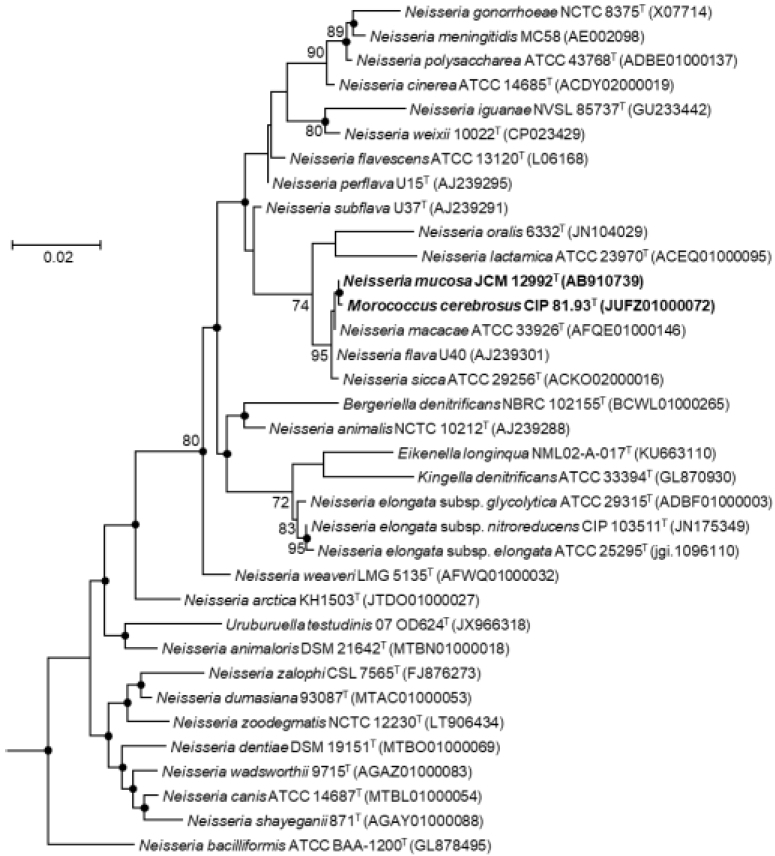
Maximum-likelihood tree showing the 16S rRNA gene sequence relationship of M. cerebrosus CIP 81.93T and N. mucosa JCM 12992T among the radiation of the genus Neisseria and closely related genera.Solid circles indicate nodes recovered in the Neighbor-joining tree. Numbers at the nodes represent bootstrap support (>70%) based on 1000 resampled datasets. Leeia oryzae DSM 17879T (AQXU01000006) was used as an outgroup. Bar, 0.02 nucleotide substitutions per position.
In both UBCG (Fig. 2) and GBDP (Fig. S1) trees, M. cerebrosus CIP 81.93T and N. mucosa JCM 12992T formed a tight cluster independent of their close neighbor, N. macacae ATCC 33926T.
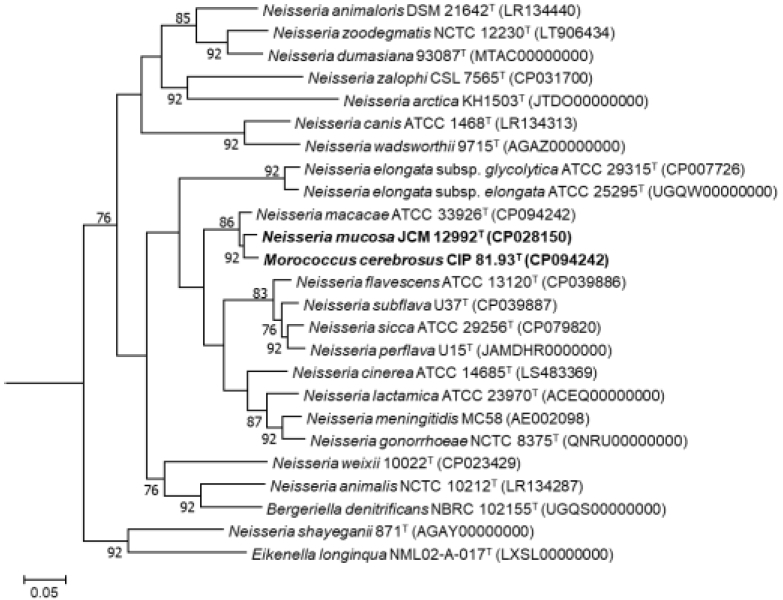
Genome-based phylogenetic tree constructed using the up-to-date bacterial core gene set.The concatenated alignment of 92 core genes was analyzed using the UBCG pipeline. Numbers at the nodes represent bootstrap support (> 70%) based on 1000 resampled datasets. Leeia oryzae DSM 17879T (AQXU01000006) was used as an outgroup. Bar, 0.05 nucleotide substitutions per position.
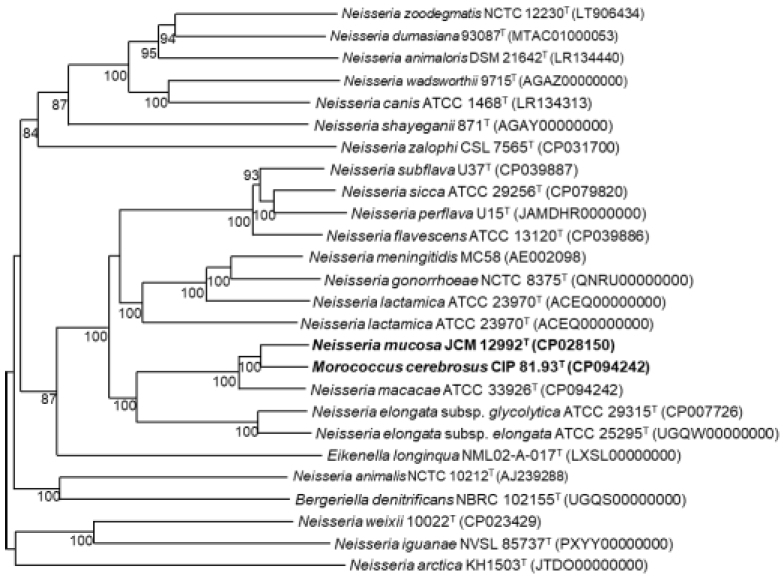
Genome-based phylogenetic tree constructed using Genome Blast Distance Phylogeny and the Type Strain Genome Server. Numbers at the nodes represent bootstrap support (>70%) based on 100 resampled datasets.
Genomic characteristics
ANI and dDDH values between the M. cerebrosus CIP 81.93T and N. mucosa JCM 12992T were determined to be 96.76% and 72.9%, respectively (Table 1). These values exceeded the recommended thresholds of 95-96% for ANI and 70% for dDDH, which are commonly used for bacterial species delineation.

The sequence similarities between Morococcus cerebrosus CIP 81.93T and closely related type strains for which genome data are available in public databases.
Phenotypic characteristics
Strains M. cerebrosus CIP 81.93T and N. mucosa JCM 12992T, along with closely related type strains, exhibited similar fatty acid profiles (Table 2), characterized by a predominance of C16:1 ω7c and/or C16:1 ω6c (summed feature 3) and C16:0, although detailed compositions varied. In API NH tests, all strains were positive for acidification of D-glucose, D-fructose, D-maltose, and sucrose, as well as for proline arylamidase activity, while all strains were negative for penicillinase, ornithine decarboxylase, urease, lipase, alkaline phosphatase, β-galactosidase, and indole production. In API ZYM tests, all strains were negative for esterase (C4), leucine arylamidase, cysteine arylamidase, trypsin, acid phosphatase, naphthol-AS-BI-phosphohydrolase, α-chymotrypsin, α-galactosidase, α-glucosidase, α-mannosidase, α-fucosidase, β-glucuronidase, and N-acetyl-β-glucosaminidase activities. Consistent with these results, no single phenotypic property differentiated M. cerebrosus CIP 81.93T from N. mucosa JCM 12992T. However, N. macacae ATCC 33926T and N. sicca ATCC 29256T could be distinguished by the presence of gamma glutamyl transferase activity or the absence of valine arylamidase activity.
Differential characteristics of Morococcus cerebrosus and closely related type strains. Strains: 1, M. cerebrosus CIP 81.93T; 2, N. mucosa JCM 12992T; 3, N. macacae ATCC 33926T; 4, N. sicca ATCC 29256T. +, positive; w, weakly positive; -, negative; ND, Not detected. Values are percentages of total fatty acids. Fatty acids representing more than 1 % are shown. All data listed were obtained in this study.
Conclusion
On the basis of high genomic relatedness (96.76% ANI and 72.90% dDDH), exceeding the commonly accepted species delineation thresholds (95-96% ANI and 70% dDDH), as well as high 16S rRNA gene sequence similarity (99.93%), and indistinguishable chemotaxonomic and phenotypic characteristics, it is clear that the two type strains belong to the single species. Thus, we propose that Morococcus cerebrosus CIP 81.93T is a later heterotypic synonym of Neisseria mucosa JCM 12992T.
References
-
Long P, Sly L, Pham A, Davis G. Characterization of Morococcus cerebrosus gen. nov., sp. nov. and comparison with Neisseria mucosa. International journal of evolutionary microbiology. 1981;31(3):294-301.
[https://doi.org/10.1099/00207713-31-3-294]

-
SH Yoon, SM Ha, S Kwon, J Lim, YKim, H Seo et al. Introducing EzBioCloud: a taxonomically united database of 16S rRNA gene sequences and whole-genome assemblies. International journal of evolutionary microbiology. 2017;67(5):1613-1617.
[https://doi.org/10.1099/ijsem.0.001755]
-
YS Jeon, K lee, SC Park, BS Kim, YJ Cho, SM Ha et al. EzEditor: a versatile sequence alignment editor for both rRNA-and protein-coding genes. International journal of evolutionary microbiology. 2014;64:689-691.
[https://doi.org/10.1099/ijs.0.059360-0]
-
Kumar, S., G. Stecher, and K. Tamura. MEGA7: molecular evolutionary genetics analysis version 7.0 for bigger datasets. Molecular biology and evolution. 2016;33(7):1870-1874.
[https://doi.org/10.1093/molbev/msw054]
-
SI Na, YO Kim SH Yoon, S Ha, I Baek, J Chun. UBCG: up-to-date bacterial core gene set and pipeline for phylogenomic tree reconstruction. Journal of microbiology. 2018;56(4):280-285.
[https://doi.org/10.1007/s12275-018-8014-6]
-
Meier-Kolthoff JP, Carbasse JS, Peinado-Olarte RL, Göker M. TYGS and LPSN: a database tandem for fast and reliable genome-based classification and nomenclature of prokaryotes. Nucleic acids research. 2022;50:D801-D807.
[https://doi.org/10.1093/nar/gkab902]
-
I Lee, Y Ouk Kim, SC Park, J Chun. OrthoANI: An improved algorithm and software for calculating average nucleotide identity. International journal of evolutionary microbiology. 2016;66(2):1100-1103.
[https://doi.org/10.1099/ijsem.0.000760]
-
Meier-Kolthoff JP, Auch AF, Klenk H-P, Göker M. Genome sequence-based species delimitation with confidence intervals and improved distance functions. BMC Bioinformatics. 2013;14(1): 60.
[https://doi.org/10.1186/1471-2105-14-60]